
Choose your coordinate system wisely!
Which axes span the solution space minimally and completely?


“Solution space”!? “Minimally”!? “Completely”!? When looking for a solution to a problem, I must first understand the problem. Which parameters are crucial? I analyse the parameters and look for those that are independent of one another. Once I’ve found a set of independent parameters that model the problem with sufficient accuracy—or even solve it analytically—I’ve found a minimal and complete set of parameters. They span the solution space. They form a coordinate system.
Do you think this is just for mathematicians and physicists and their problems? Does it sound too abstract to you? You’d better familiarize yourselves with this way of thinking quickly, because it’s the Swiss Army knife, the WD-40, the universal tool that cuts across virtually every serious discipline in which one seeks to understand complex systems. It even helps with problems like the following:
Should I organize my photos on my computer into folders and subfolders based on the date they were taken? Or should I put all the photos from an event into a folder with the same name, such as “Wolfgang’s 55th Birthday”? Should I keep them separate at all, or should I group them together with other types of documents in folders?
I’m trying to categorize all the ideas that ended up on a whiteboard as Post-its during a brainstorming session. What criteria should I use to group the Post-its?
Which axes span my solution space minimally and completely is the universal question regarding the factors—independent of one another—that are relevant to understanding and solving the problem. All other factors can be ignored. I call parameters that are independent of one another “orthogonal.” For me, this is one of the most vivid metaphors for independent parameters.
Orthogonal parameters allow us to consider and modify each degree of freedom of the problem in isolation, without the others shifting along with it. This is precisely why, in physics—for example, with a pendulum oscillating in a plane—we choose polar coordinates instead of Cartesian coordinates: the motion has only one degree of freedom (angle). In Cartesian coordinates (x, y), one would have to constantly include a constraint that actually provides no additional information (x and y are directly dependent on each other due to the pendulum’s fixed suspension and the constant length of the string).
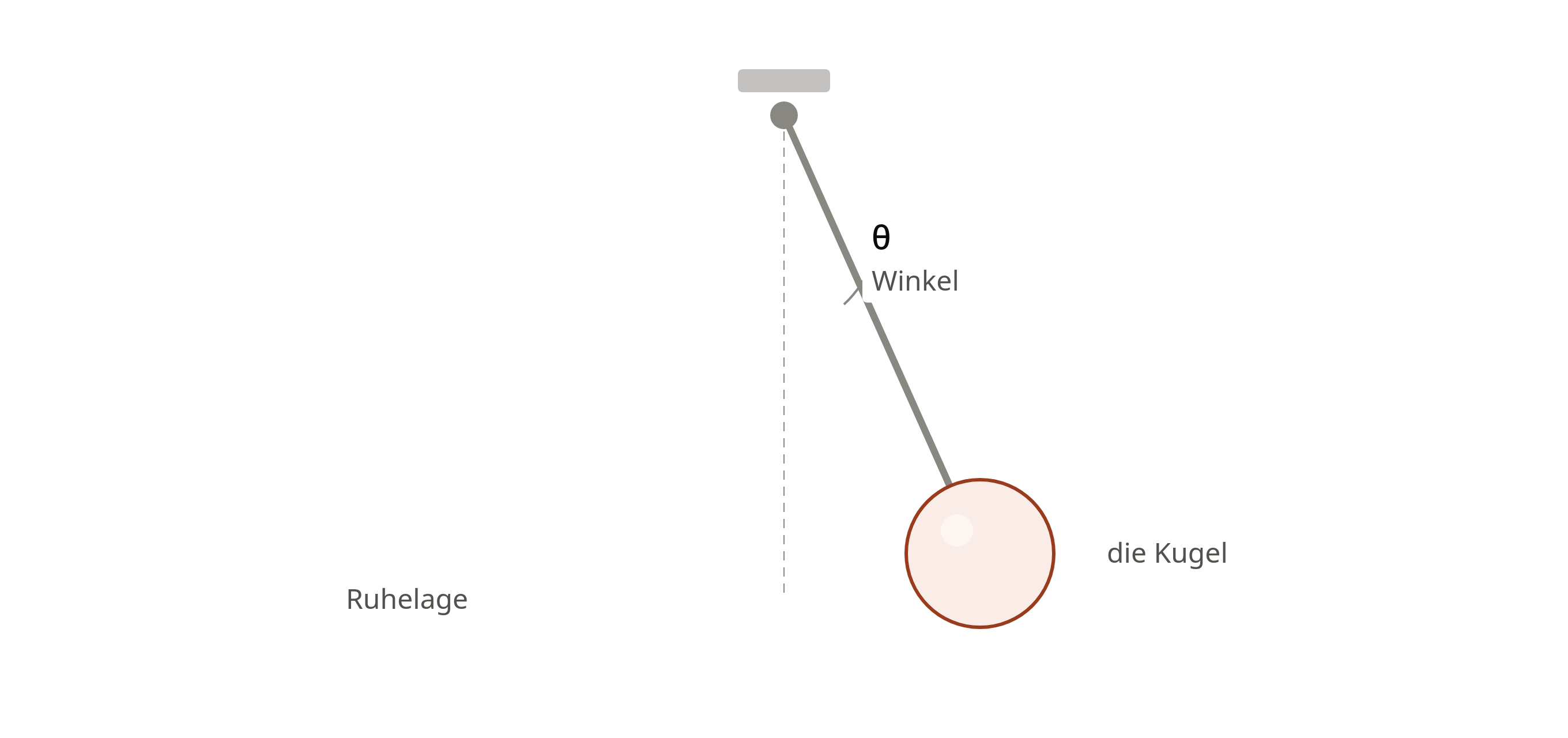
If two selected factors were to correlate, one would effectively be measuring the same effects twice. This not only makes the problem—or rather, the modelling of the problem—unnecessarily complex, but also makes the results difficult to interpret. This is the classic problem of multicollinearity in regression. The more redundant parameters are included, the larger and more opaque the solution space becomes. Instead, we reduce the dimensions.
It’s important to note that there is often not just a single suitable coordinate system. There are often several, but we’re looking for the one that makes the structure of the problem immediately apparent. So it’s not just about reduction alone, but about finding the basis in which the problem reveals its “natural” structure.
Do I always find a natural, minimal coordinate system? Sometimes not; sometimes I’m not sure if it’s complete. Sometimes I have several that all seem well-suited. Which one do I choose then? My advice is to test them on sample data. Work pragmatically with the parameters that appear to be most independent of one another. Experiment and keep working, but don’t lose sight of the goal of reducing the dimensions.
A few more specific tips:
• Orthogonality over completeness. It’s better to have a few clearly distinct parameters than many that overlap. Completeness can be refined later; eliminating redundancy is much harder.
• Look for invariants. What remains constant, no matter how the rest of the system changes? These are often the actual axes of the coordinate system—such as conserved quantities in physics or invariants in software architecture, like interfaces that do not change with the implementation.
• Take advantage of symmetries. A well-chosen system reveals the symmetries of the problem, such as spherical coordinates for radially symmetric problems. In non-physical domains, this often corresponds to choosing a level of abstraction at which special cases disappear because they are actually special cases of a more general case.
The application of this principle in communication is particularly fascinating and worth mentioning. Especially when misunderstandings can easily arise—for example, because the audio connection in a remote session is poor or there are a large number of participants—it helps immensely to identify the few, independent, natural nuggets of information that I need to convey so that everyone can fully participate in a discussion. No getting sidetracked by irrelevant details that are merely special cases. No complicated sentences with redundant facts. Simple language. Clear words.